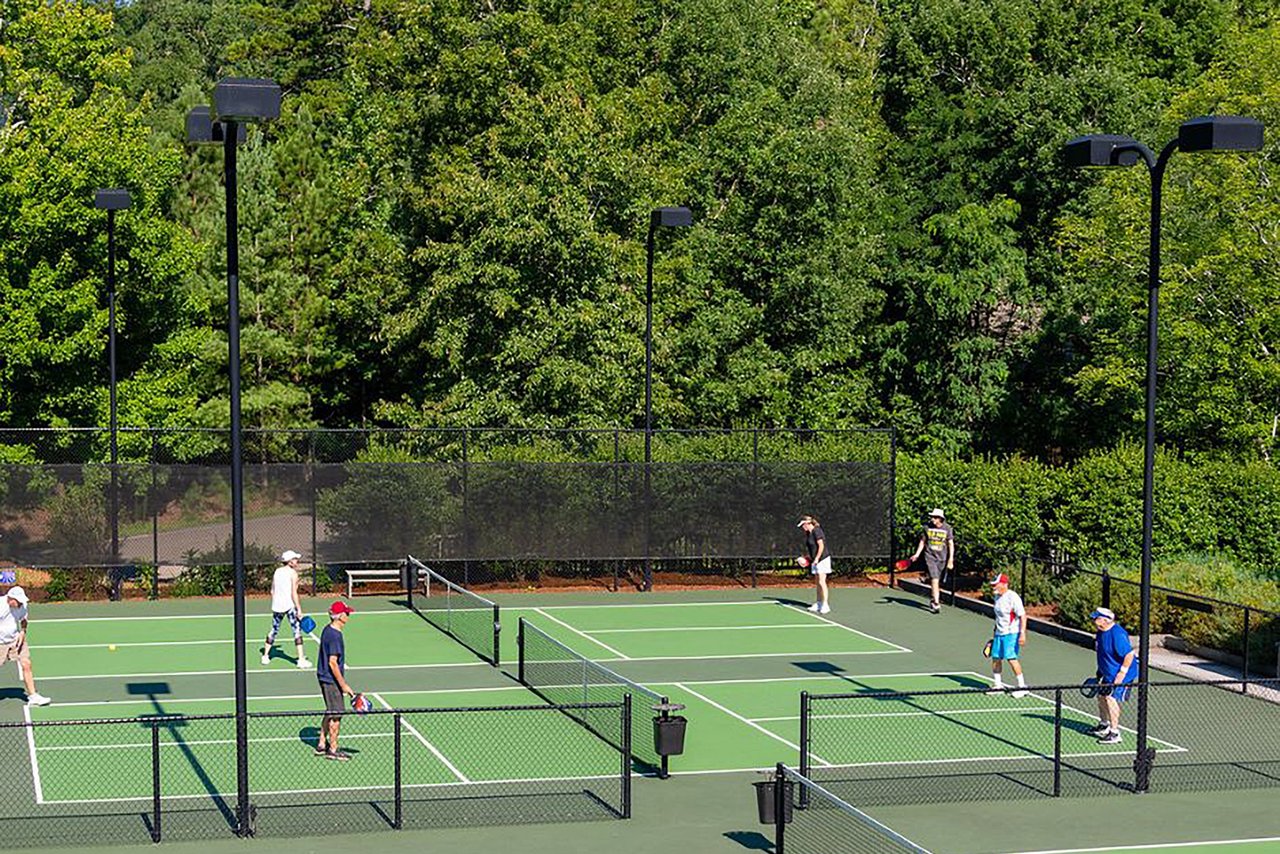
Ask a longtime Big Canoe resident what sport the Racquet Club was built for, and most will say tennis. It is the assumption baked into decades of habit: two clay courts here, a doubles match there, the club as a tennis institution with pickleball tacked on as the newer, smaller sibling. The actual court count on Wolfscratch Circle tells a different story. The facility runs 18 total courts, and 10 of them are dedicated to pickleball. Tennis, split between six outdoor and two indoor courts, gets eight. Pickleball has the plurality.
That is not a marginal split. It means the sport most residents still think of as the upstart now controls more than half the court real estate at the club that supposedly belongs to tennis. If you are trying to figure out when you can actually get on a court, or which sport has more room to breathe on a Saturday morning, that ratio matters more than any general description of "racquet sports amenities" ever will.
The Court Math Nobody Splits Evenly
The club counts more than 300 active players sharing those 18 courts, a number that covers both sports rather than pickleball alone. Spread that population across a facility where pickleball holds 10 courts and tennis holds 8, and the practical effect shows up fastest at peak hours, when a court that used to be a coin flip between two tennis regulars is now competing against a much larger and still-growing pickleball crowd for the same clock.
Here is how the space actually breaks down:
Court Type | Count | Location |
|---|---|---|
Outdoor tennis | 6 | Wolfscratch Circle |
Indoor tennis | 2 | Wolfscratch Circle |
Pickleball | 10 | Wolfscratch Circle |
Ten courts sounds generous until you remember pickleball's national growth curve has made it the fastest-adopted racquet sport in the country over the past several years, and Big Canoe's demographic, heavy on retirees and second-home owners looking for lower-impact recreation, is exactly the population driving that curve. The club did not add a token pickleball corner. It built a facility where pickleball is the larger half.
Thursdays Belong to Beginners
If you are new to the sport, the club has already made the decision for you: beginner pickleball clinics run every Thursday. That is the one slot built specifically for people who have never picked up a paddle, and it means the calendar math is simple. If you want structured instruction rather than showing up and hoping a patient regular takes you under their wing, Thursday is the day, not a flexible suggestion.
For players who want more than a weekly clinic, the club also offers private and group lessons with a USPTA-certified teaching professional. That is a meaningful distinction for anyone weighing whether to invest real time in the sport this fall. A beginner clinic gets you through the basic rules and paddle mechanics. A certified instructor is what turns casual play into something closer to competitive.
The Sport That Runs on Its Own Card
Bocce does not fit neatly into the tennis-versus-pickleball framing, and that is worth knowing before you assume every racquet sport at Big Canoe operates under one membership. Bocce runs its own organized league play in both spring and fall seasons, and participating in a league requires a separate bocce membership. Court and clinic access for tennis and pickleball does not automatically carry over.
There is a workaround for casual players: you can join a league team as a substitute when a regular member is unavailable, without holding a full membership yourself. That is a useful entry point if you want to test the sport before committing to a season, and it is the kind of detail that only shows up when you look past the general amenity list and into how each program is actually structured.
What the Pro Shop Now Sells
The Racquet Club's pro shop has been reimagined recently, and what it stocks now says something about how the club sees itself. Alongside athleisure, court apparel, and gear for tennis, pickleball, and bocce, the shop carries hiking essentials and a dedicated dog-supply corner. That is not standard inventory for a facility organized strictly around court sports. It reads as a club that has become a general gathering point for residents moving between the trail, the court, and the dog park in the same afternoon, rather than a single-purpose athletic building.
For anyone picturing the Racquet Club as a narrow, competitive tennis scene, that inventory list is a quiet correction. The club's own retail choices suggest a facility built around the rhythm of daily life in Big Canoe, not just serious match play.
Getting On a Court This Month
If you are trying to actually use these numbers rather than just read them, here is how the pieces fit together for a resident planning the next few weeks:
- If you are picking up pickleball for the first time, plan around the Thursday beginner clinic rather than trying to learn on a crowded open-play court.
- If you already play and are frustrated by court availability, remember the math: 10 pickleball courts are absorbing a larger and faster-growing share of the club's 300-plus active players than the 8 tennis courts are.
- If bocce interests you, decide whether you want a full membership for the spring or fall league or whether substituting for a team first makes more sense while you learn the pace of the game.
- If you want structured improvement rather than casual play, book time with the club's USPTA-certified pro rather than relying on clinic time alone.
- Before assuming any court sport is bundled with racquet club access, confirm which membership category covers the specific sport you want, since bocce sits outside the standard tennis and pickleball structure.
None of this requires guesswork. It requires knowing that the club's court count, clinic schedule, and membership tiers are not one uniform system, but three sports running on slightly different rules under the same roof.
A Community That Adjusts As It Grows
The broader lesson here is not really about paddles or courts. It is about how a community like Big Canoe evolves its amenities in response to what residents are actually doing, not what they did a decade ago. A facility that quietly shifted from tennis-first to pickleball-plurality, added a dog-supply corner to its pro shop, and built a separate season structure for bocce is a facility paying attention to its own membership rather than defending an old identity.
That kind of responsiveness is worth knowing about whether you are already playing three days a week or you are simply weighing what daily life inside the gates actually looks like. The amenities here are not static descriptions on a brochure. They shift, sometimes in ways the general marketing never quite catches up to.
If you are thinking about what life in Big Canoe looks like day to day, whether that is court time, trail access, or just understanding how a specific neighborhood inside the gates actually operates, Steve Yambor has spent close to 20 years living here and can talk through the details that do not show up in a listing sheet. Let's Connect.